
Stop Making Promises to the Person You Think You Should Be

Sometimes the need for change is impossible to ignore. Something is falling apart. You are exhausted, unfulfilled, disconnected, or repeating a pattern that has become too painful to keep pretending you do not see. You know something has to change, even if you have no idea where to begin.
Other times, the need is quieter. Your life may be going well. You are handling your responsibilities, showing up for the people around you, and doing most of what needs to be done. Nothing is necessarily wrong, but somewhere along the way, an important part of your life stopped receiving your attention. Your health slipped into the background. Your relationships became functional instead of connected. Your creativity disappeared beneath obligation. Your dreams became things you would eventually return to.
Whether the need for change is screaming or whispering, most of us respond in one of two ways. We ignore it, or we try to change everything at once. I spent years choosing the second option.
The Superhero I Kept Trying to Become
Whenever I reached a point where I was tired of my life, my habits, or myself, I would build a dramatic new plan. I would decide that this time was different. I was going to completely reinvent myself, become disciplined, fix every neglected area, and finally live up to the person I believed I was supposed to be.
For a little while, it worked. Then the momentum wore off, life became busy, and the plan became heavier than my ability to carry it. I found myself slipping back into the same patterns I had promised I would leave behind, and eventually I would try again. Different planner, different routine, different declaration. Same approach.
At some point, repeating the same method and expecting a different result stopped looking like persistence and started looking like insanity.
What I could not see at the time was that I was holding myself to the standard of a superhero without ever taking the time to understand the human being underneath him. I knew who I thought I should be, but I had very little curiosity about who I actually was. I did not ask what I realistically had the capacity for in that season. I did not consider how much fear, shame, exhaustion, or uncertainty I was carrying. I did not meet myself where I was in the journey. I only measured the distance between who I was and who I thought I should already be, and every time I failed to close that distance fast enough, I used it as evidence against myself.
The Trust I Did Not Know I Had Broken
When I first encountered the idea of self trust, I was resistant to it. Of course I trusted myself. Consciously, I did. I believed in my intelligence. I knew I could survive hard things. I saw myself as capable, resourceful, and independent.
But self trust does not only live in what we consciously believe about ourselves. It also lives in the agreements we make with ourselves, the actions that follow those agreements, and the patterns our deeper mind learns through repetition. I could tell myself that I was capable of changing, but another part of me had watched me make the same dramatic promises and abandon them again and again. That part of me had evidence too.
If I had a friend who constantly invited me to the gym, acted excited about going, and then disappeared after the third day every single time, I would eventually stop believing him. I would not get excited about the next plan. I would expect the enthusiasm to fade.
That was the relationship I had built with myself. I kept making promises to an idealized version of me and leaving the actual version of me to deal with the disappointment.
The problem was not that I lacked ambition. The problem was that my ambition had become disconnected from honesty, and some deeper part of me no longer believed my declarations because I had given it very little reason to.
Starting Smaller Than My Pride Wanted
Rebuilding that trust required me to approach change differently. I had to stop trying to repair every part of my life at once and choose one area to attend to. For me, that area was purpose and work.
I did not have the language for a wheel of life at the time, but I was beginning to understand its deeper lesson. My life was made of several important areas, and I could not give all of them my full attention at once. I had to stop asking, "How do I fix my entire life?" and start asking, "Which part of my life needs me most right now?"
I returned to school, committed myself to learning, and began slowly proving that I could follow through. Not for one inspired week, but for semesters.
Only after I had created some stability there did I add something new. I decided to try kickboxing, but instead of demanding that I become a completely different person overnight, I gave myself one goal: go once a week. That sounded small, almost too small.
Even then, the first two weeks did not look particularly impressive. I drove to the gym, parked outside, looked at the entrance, and drove home. Twice.
The version of me who lived by the superhero standard would have called that failure. He would have used those two trips as proof that I was lazy, afraid, or not committed enough. But this time, I tried to see it differently. I had still driven there. I was closer than I had been before. Something in me wanted to walk through that door, and something else was clearly afraid. Instead of attacking that fear, I became curious about it.
On the third attempt, I went inside.
Once I became comfortable, I made the mistake I had always made. I felt good, so I immediately pushed myself to go three times a week, and it was not long before I found myself back at the door, ready to abandon the whole thing. Only this time, I caught the pattern. I did not need to quit. I needed to return to the promise I could actually keep. So I gave myself permission to go once a week, and I went.
Once a week slowly became twice. Twice became three times. Eventually, I was going four times a week. None of that happened because I shamed myself into becoming stronger. It happened because I stopped treating where I was as an inconvenience.
Meeting yourself where you are does not mean deciding you will stay there. It means choosing a starting point you can actually build from.

Resistance Is Not Always a Stop Sign
We tend to interpret resistance in one of two ways. Either we treat it as proof that we should stop, or we attack it as weakness and try to overpower it. Neither response gives us much useful information.
Resistance can mean many things. You may be afraid of failing, but you may also be afraid of succeeding and having more expected of you. You may fear rejection, visibility, conflict, disappointment, or losing an identity that has kept you safe. You may be overwhelmed because the step is genuinely too large for your current capacity. Sometimes resistance is protecting a wound. Sometimes it is protecting a familiar life you have already outgrown. Sometimes it is simply asking you to slow down long enough to understand what you are actually committing to.
Compassion does not mean allowing resistance to make every decision, and curiosity does not mean giving yourself an endless excuse to avoid discomfort. It means listening before you lead.
There is a difference between a step that stretches you and one that floods you. Growth requires discomfort, but not every form of discomfort creates growth. Sometimes we push ourselves so far beyond our capacity that the experience only teaches us to retreat further the next time. The right next step should ask something of you. It should require honesty, courage, or effort. But it should still be a step.
Change Does Not Always Begin With a Crisis
It is easy to notice what needs attention when your life is falling apart. It is harder when your life is mostly working.
You can become so competent at handling your responsibilities that you stop noticing the areas where you are merely surviving. You may be successful at work while neglecting your health. You may have a stable relationship but avoid the conversations that would create deeper intimacy. You may take care of everyone around you while losing contact with your own interests, needs, and direction. There may be no emergency, but that does not mean there is nothing asking to be seen.
Sometimes growth begins with pain. Sometimes it begins with the quiet recognition that something meaningful has been left unattended.
The question is not necessarily, "What is wrong with my life?" A more useful question may be, "What part of my life is asking for my attention now?"
Looking at the Whole Without Trying to Fix the Whole
One of the most useful ways to answer that question is to step back and look at your life as a whole. Not to judge it. Not to compare it to someone else's. Not to create seven new goals before Monday. Simply to notice.
A wheel of life can help us look at several important areas:
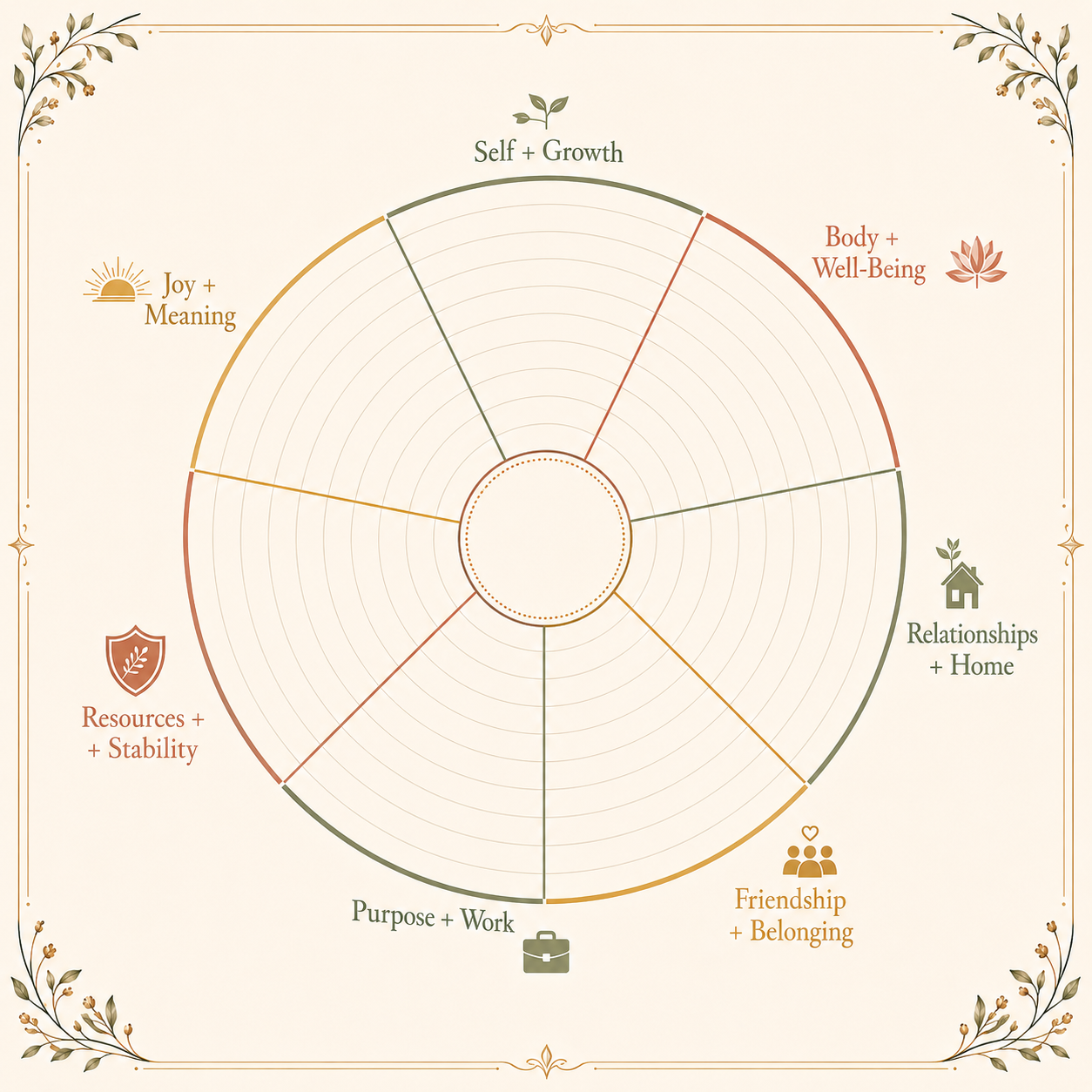
Self and growth
Body and well-being
Relationships and home
Friendship and belonging
Purpose and work
Resources and stability
Joy and meaning
These areas do not need to be perfectly balanced. There will be seasons when work requires more of you. There will be seasons when your health, family, finances, or healing need to move closer to the center. Balance does not always mean giving everything an equal amount of time. It means remaining conscious of what you are choosing and what your choices are costing you.
The goal of the wheel is not to produce a perfect score. It is to help you notice the one door that may be asking to open.
As you look across the different areas of your life, pay attention to your reactions. Where do you feel longing? Where do you immediately become defensive? Which area do you rush past because you already know what it will show you? Where do you feel proud and aligned? Where have you quietly settled for functioning?
The area with the lowest score is not automatically where you need to begin. Sometimes an area is temporarily limited for reasons outside your control. Sometimes another area carries more energy, possibility, or importance even if it looks better from the outside. You are not looking for the most broken part of your life. You are looking for the most honest place to begin participating again.
That was purpose and work for me. Later, it became my physical well-being. Your door may be different. It may be a relationship that needs a conversation, a body that needs care, a friendship you have neglected, a financial reality you have avoided, or a creative part of yourself that has gone quiet.
You do not need to walk through every door today. Choose one.
Making an Honest Promise
Once you know which area needs attention, the next question is not, "How do I completely transform it?" Ask yourself instead:
What is this area of my life honestly asking from me?
What have I been promising myself here but not following through on?
Is the step I keep choosing appropriate for where I actually am, or is it sized for the person I think I should be?
What resistance appears when I imagine taking action, and what might it be protecting?
What would a smaller but still meaningful promise look like?
Can I keep that promise consistently enough to begin believing myself again?
Your next step does not need to impress anyone. It does not need to prove that you are finally serious. It needs to be honest.
Maybe your next step is not working out five days a week, but putting on your shoes and walking for ten minutes. Maybe it is not rebuilding your entire relationship, but telling the truth about one thing you have been avoiding. Maybe it is not discovering your life's purpose, but spending one hour doing something that makes you feel alive again. Maybe it is not completely repairing your finances, but finally opening the account, looking at the numbers, and deciding what needs to happen next.
A small step is not meaningless when it changes your relationship with yourself. You do not rebuild self trust by making more impressive promises. You rebuild it by making honest promises and becoming someone who keeps them.
Your Next Honest Step
This is the work at the heart of my workshop, Your Next Honest Step, part of The Practice of Becoming series at Ixora, A Wellness Collective.
The class is for anyone craving meaningful change but unsure where to begin. It is also for those whose lives may be going well, but who sense that an important area has gone unattended or become too familiar to notice clearly. Together we use the wheel of life to look honestly at the different areas of your life, identify the one that is asking for attention, explore what resistance may be protecting, and choose one meaningful step that fits where you actually are.
Not the biggest step. Not the most impressive step. The next honest one.
You do not have to become someone else before you can begin changing your life. You have to learn how to meet the person who is already here, tell them the truth, and take one step together.
Continue Exploring These Themes on the New Ashla Podcast
Survival Instincts vs. Modern Reality: The Mental Clash Nobody Talks About
Explore why the mind clings to familiarity and conserves energy, how our comfort zones quietly shrink, and why meaningful growth requires conscious, sustainable effort rather than another dramatic overhaul.
You’re Busier Than Ever and More Lost Than Before
A deeper look at the difference between being occupied and consciously participating in your life, including how to redirect your attention toward what genuinely creates meaning, direction, and connection.
With love and gratitude,
Michael Perry Ad Lucem
