There's a version of isolation that doesn't look like isolation at all. It looks like a full calendar and an empty week. It looks like "I'm just really busy right now." It looks like telling yourself you're in a season of focus, of healing, of getting your life together. And technically, none of that is a lie. You go to work. You come home. You do it again. And somewhere in that loop, months go by, and you realize you can't remember the last time you sat across from someone who actually knows you.
I know that loop well, because I've lived it more than once.
For most of my life, I've been the person who brings people together. Game nights, parties, road trips, gatherings, introducing friends who I knew would click. Connecting people has always felt natural to me. Which is exactly why it took me so long to admit how many phases of my life I've spent completely walled off.
COVID was one of them. Like so many people, my world shrank down to a two-point cycle: work, then home. Work, then home. For months and months. There was no dramatic moment where I chose isolation. The world chose it for me, and my nervous system quietly adapted to it. I'm still recovering from that adaptation, honestly. The world reopened years ago, but the muscle I used to reach for people didn't come back just because the doors did.
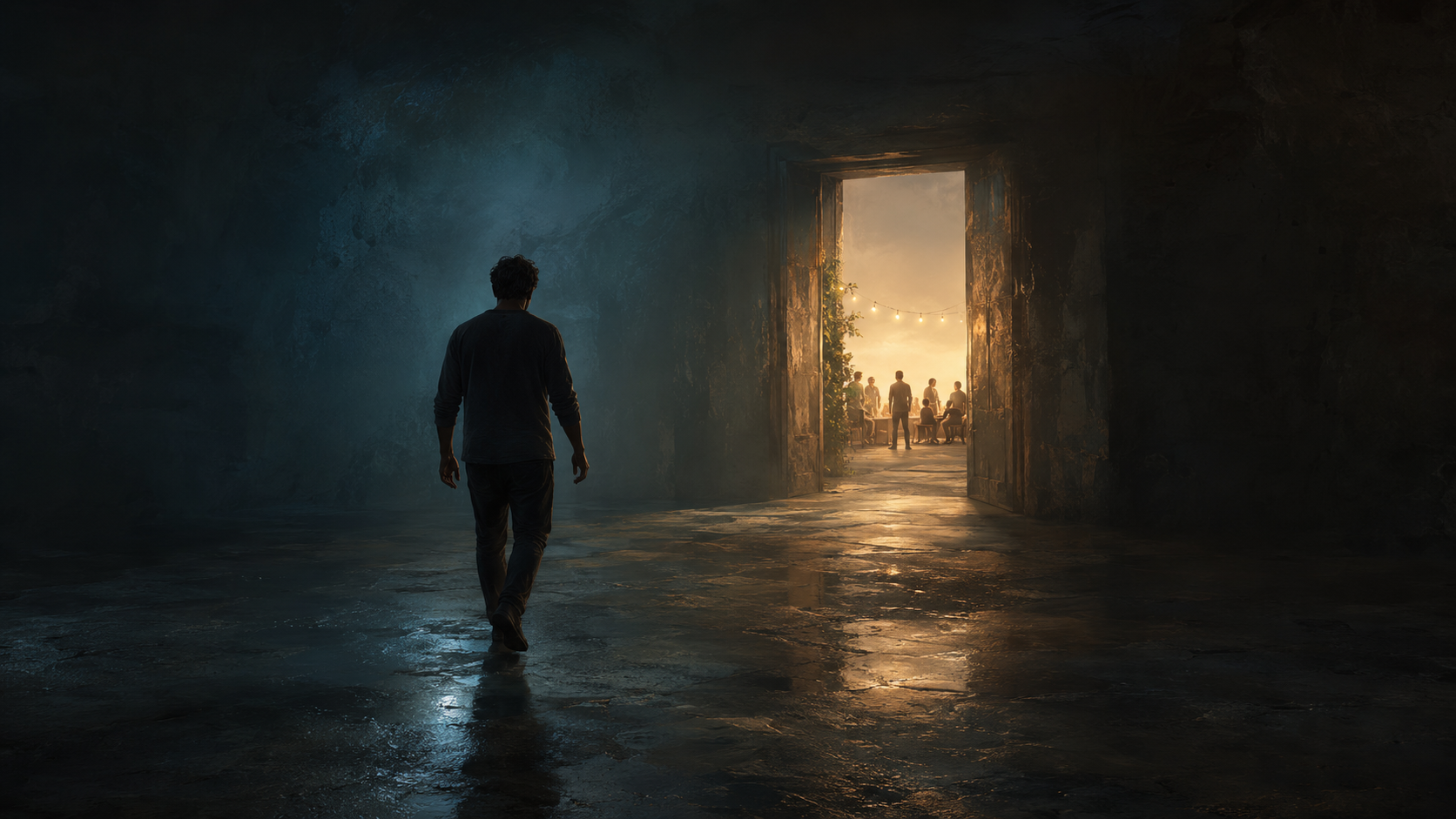
Then there were the seasons grief built. Death, betrayal, heartbreak. Each one taught me, in its own language, that people are where the pain comes from. So I pulled back further. And in one chapter of my life, a toxic relationship did the pulling for me. Not all at once. That's never how it works. One connection at a time, one canceled plan at a time, one "we don't really see them anymore" at a time, until the relationship was the only room left in my life and I couldn't remember choosing to close all the other doors.
Three very different roads. All of them ended in the same quiet place.
Solitude Is Medicine, but the Dose Is Everything.
I want to be careful here, because I'm not about to tell you that being alone is the enemy. It isn't. Some of the most important work of my life happened in solitude. Time alone is where reflection lives. It's where we cultivate skills, sit with hard truths, and hear ourselves think without the noise of everyone else's expectations. Every tradition worth its salt honors the retreat, the wilderness season, the deliberate stepping back.
But medicine and poison are usually the same substance at different doses.
Somewhere past the healthy dose, solitude stops being reflection and starts becoming stagnation. And stagnation is not neutral. Stagnation is the slow atrophy of the will. It works exactly like an unused muscle. You don't feel it weakening day to day, but the longer the will shrinks, the harder it becomes to generate the strength required to pull yourself out. The very faculty you need to escape isolation is the one isolation quietly disolves. That's the trap. It's not a cage with bars; it's a cage that makes the door heavier every week you don't open it.
What Actually Happens to Us Alone
Here's the part nobody warned me about. In long isolation, you become your own best friend, your own only friend, and that sounds almost sweet until you realize who else lives in your head with you.
The inner critic doesn't take seasons off. And with no other voices in the room, it stops being one perspective among many and becomes the narrator of everything. It distorts your external reality: they didn't text back because you don't matter to them. It distorts your internal reality: you're behind, you're broken, you've always been this way. With no mirror but your own mind, you lose the ability to tell the difference between what's true and what's just loud. And slowly, a sense of purpose drains out of your days, because purpose, for most of us, is braided into belonging and contribution. We are wired to matter to someone. When there's no one to matter to, the question "what's the point?" starts winning arguments it should never win.
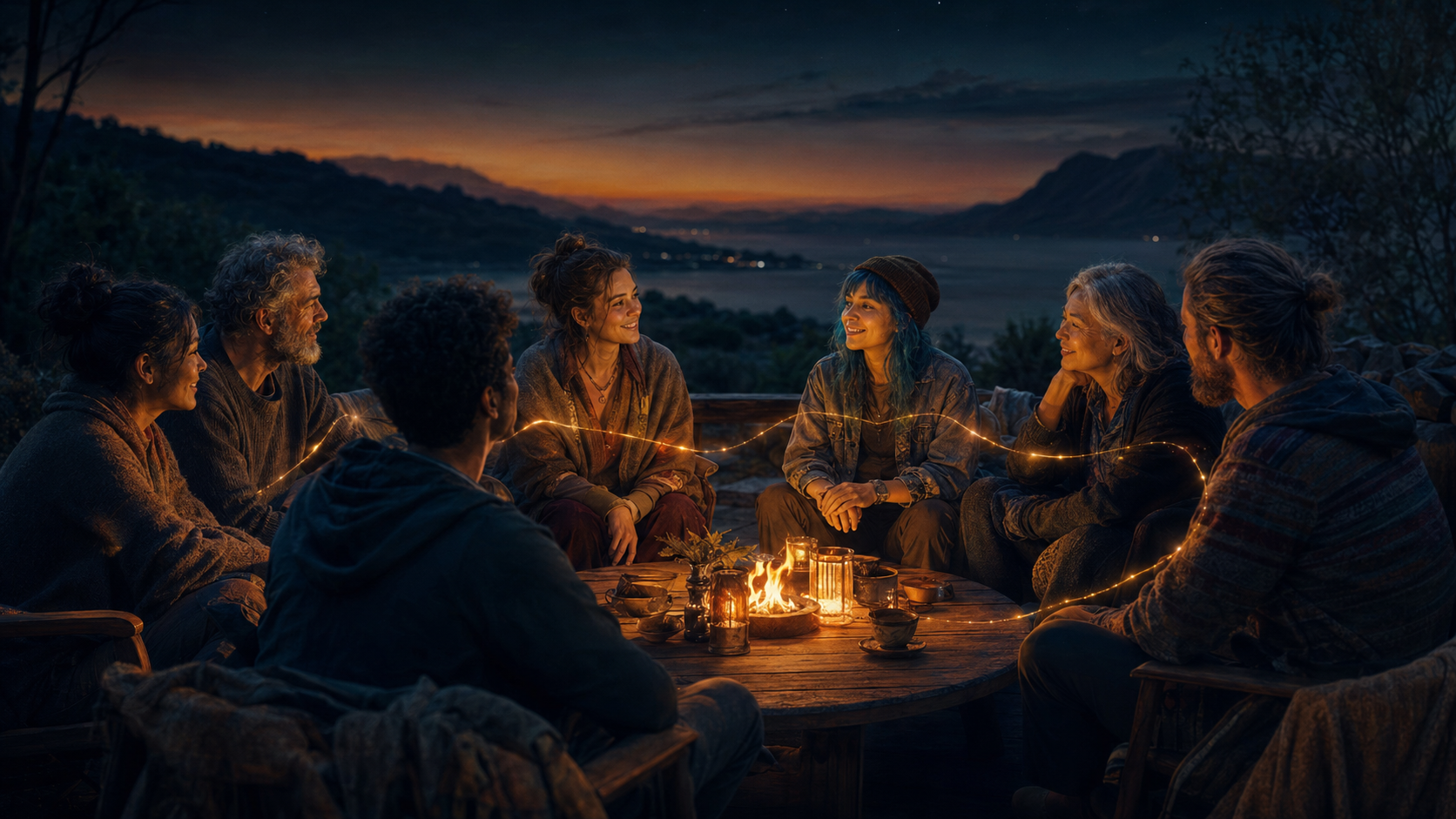
This is what connection actually does, underneath the surface of dinners and phone calls. Connection gives us a mirror we cannot be for ourselves. Other people reflect back the parts of us the inner critic edits out. Connection makes us accountable, because it's a lot harder to abandon yourself in front of witnesses. It pushes us further than we would ever push ourselves alone, and it challenges our perspective just by existing, because another person's reality constantly reminds us that ours is one angle, not the whole picture.
None of that is weakness. That's infrastructure.
The Boulder
Every time I've climbed out of an isolation phase, and I've done it more than once now, it worked the same way. And it never worked the way I wanted it to.
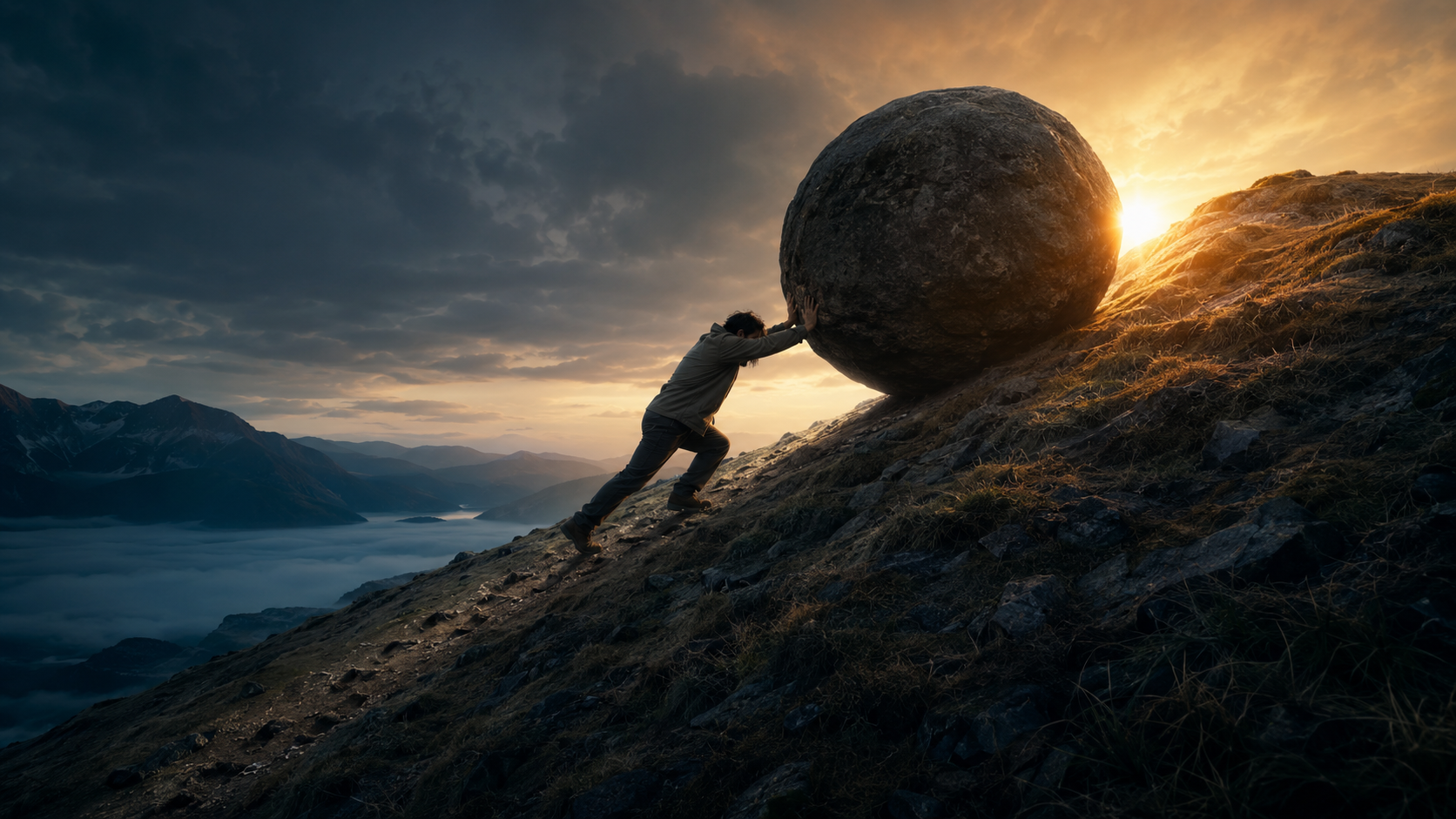
I wanted a switch. One good weekend, one deep conversation, one burst of motivation that would flip me back into the connected person I used to be. That switch does not exist. What exists is a boulder at the bottom of a hill.
Getting out was always intentional effort that compounded. One text I didn't want to send. One invitation accepted with dread in my stomach. One honest conversation where I let someone see where I actually was instead of performing where I wished I was. Each push felt dispraportionately hard for how small it looked from the outside. That's what pushing a boulder uphill feels like. But effort like that stacks. The muscle rebuilds. And there is a point, and you can feel it when it comes, where the boulder crests the hill and momentum starts working for you instead of against you. Connection begins generating connection. People invite you because you came last time. Conversations get easier because you've been having them..
The other thing that mattered, maybe the thing that mattered most, was finding connections that could meet me where I was. Not people who needed me to already be healed, social, and shiny. People who could work with the version of me that existed at that stage: quiet, rusty, honest about it. If you're rebuilding, you don't start by benching your old max. You start with the weight you can actually move today, with people who don't shame you for the number.
Then Community Amplifies It
A friendship is a mirror. A community is a hall of mirrors, and I mean that in the best possible way.
When you move from isolated connections into genuine community, everything I've described gets amplified. More diversity means more perspectives pressing gently against your blind spots, which makes it much harder to calcify into one narrow story about the world or yourself. And real community carries something a single friendship usually can't: a shared standard. A good community holds an expectation of who we are becoming, of our character, our values, our contribution. It asks something of us. That's not pressure in the toxic sense. It's the same reason we train harder in a gym full of people than alone in a garage. We rise toward what's expected in the rooms we keep returning to.
And community answers the two hungers isolation starves: the drive to belong and the drive to contribute. Belonging tells you that you have a place. Contribution tells you that your place matters. Purpose lives at the intersection of those two, and I have never found a way to manufacture it entirely alone. I've stopped trying.
Start Smaller Than Your Pride Wants To
If you're reading this from inside the loop of work, home, repeat, "I'm fine," I'm not going to tell you to go build a community this weekend. That's switch-thinking, and it will collapse on you by Tuesday.
Push the boulder one honest inch instead. Reply to the person you've been meaning to reply to. Say yes to one small thing. Tell one trusted person the true sentence: I've been isolated for a while and I'm trying to find my way back. You'll be surprised how many people lean in when you say it. Most of them have been in the dark room too.
The will atrophies in isolation, but it also rebuilds the same way it was lost: gradually, then suddenly. Every small reach toward another person is a rep. You are not starting over. You are starting again, and those are not the same thing.
We were never meant to become ourselves alone. Solitude can show you who you are, but only connection lets you become it.
If you recognize yourself in this cycle and want support finding your way back, New Ashla Coaching offers a space to understand what has kept you isolated, rebuild trust in yourself and others, and begin taking the small steps that create real momentum. You can book a coaching session whenever you feel ready to stop carrying it alone.
With love and gratitude,
Michael Perry
Ad Lucem
Continue Exploring These Themes on the New Ashla Podcast
The Loneliness Epidemic: How to Stop Disappearing From Your Own Life
A deeper exploration of how isolation gradually becomes a way of life, why reaching out becomes harder over time, and how small acts of connection help us find our way back.